

Dan McNulty explores the origins of ITI Group’s entry in the 2026 AVEVA Partner Games, competing for gold at the finals in Milan – and how publicly available data and AI can help farmers and water users make better decisions without adding sensors or infrastructure.
Key takeaways
- Industrial AI overwhelmingly follows the money – process optimisation, anomaly detection, predictive maintenance. But the same tools and thinking can tackle challenges far bigger than any single operation.
- Fresh water scarcity is one of the most pressing problems on earth, and open data is crucial to tackling it together.
- ITI’s team used AVEVA’s platform and publicly available data to build an AI solution that helps farmers make better irrigation decisions – without adding sensors or infrastructure.
Where is industrial AI being used in practice?
Data science and AI solutions tend to be prioritised wherever there are profits at stake – for example, process optimisation, anomaly detection, or OEE (overall equipment effectiveness). Modern industrial sites are full of niche solutions for enhancing specific processes, and for good reason – they deliver measurable returns.
However, AI can also be applied to big data problems; even global problems, which are too complex and interconnected for purely human approaches to overcome. The tools we use every day to connect operational data across industrial sites, and turn fragmented information into a coherent picture people can act on, are not limited to plant floors and control rooms.
The question is whether we’re willing to point them somewhere else.
Some global challenges remain unsolved simply because they don’t align with traditional business goals. There are no shareholders or KPIs to worry about. Yet they affect all of us, every single day. Every time you eat at the dinner table, there is a global problem which has been overcome on your behalf – a problem you share with almost every plant and animal on earth, and many segments of industry, too.
That problem is the shortage of usable fresh water.
Why did ITI choose fresh water scarcity?
In 2024, our team tackled wind turbine failures using machine learning, but without data on real failures, read from real instruments. Without a paying customer, the data required to solve problems is surprisingly hard to acquire. We tried for the pinnacle of maintenance: predicting failures proactively. But we ended up with far too little data to work with.
So, this time, we’re using open data sources. In responding to AVEVA’s 2026 Partner Games challenge – “build solutions for real-world customer challenges” – we chose to start at the other end of the scale, with the universal challenge: shortages of usable fresh water.
Ecology and industry are often intertwined: if we can improve the availability of water sources, we can strengthen and protect every downstream industry that depends on them, including key water users in manufacturing, mining and other industrial sectors.

How secure is the UK’s water supply?
A family member inspired me to investigate open access to UK water and hydrology data, and the problem became clear immediately.
In the UK, water seems plentiful from day to day… until the weather turns, networks fail, and the gap between supply and demand suddenly widens. Our water situation is more fragile than most people realise.
For millennia, humans have struggled to keep water resources in check when conditions are dry and demand is high. The modern scientific community has made progress. Projects like Kibbutz Hatzerim demonstrate what intensive irrigation and water reclamation can achieve in otherwise unfarmable regions. But these solutions typically require decades of strategic development at a national or regional level, followed by patchy uptake and unpredictable results. Many require land operators to opt in and provide additional data, which takes time and money.
The hope is that AI-assisted models can help shift real human behaviour more quickly. In the future, AI tools will continuously adapt to emerging data and seasonal observations – but that’s still some way off. If we could predict water source behaviour for even a few days out of a month, we can help water users find better strategies without putting crops at risk.
What did ITI’s team build?
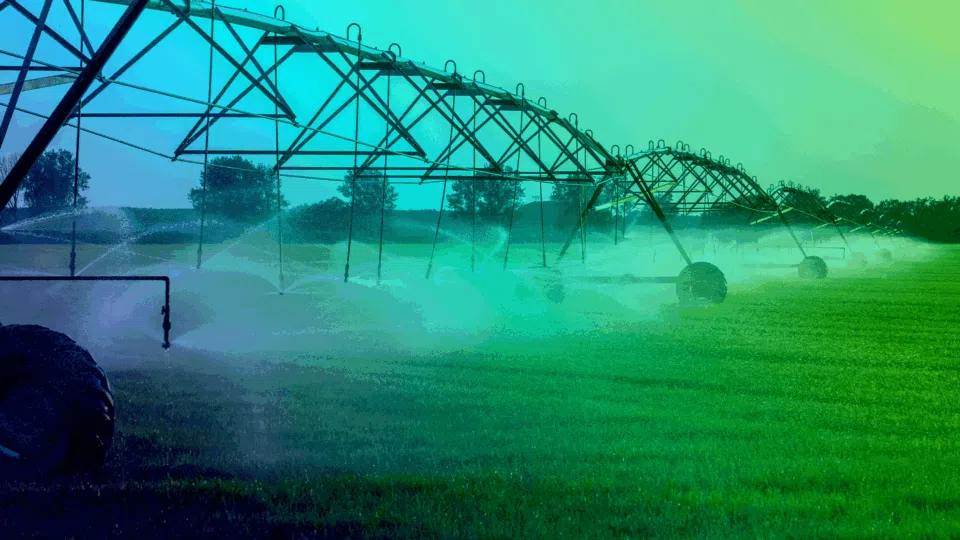
Our team of engineers at ITI sought practical advice from subject matter experts: the Hutton Institute, together with Scottish Environmental Protection Agency (SEPA) records, helped us work out where to start. The answer was irrigation, which is where most fresh water is wasted, and where better decisions can have an immediate impact.
The problem appears straightforward enough. Farmers care about crops, crops depend on soil, soil is fed water by rainfall and irrigation, irrigation draws from rivers, rivers are fed by rainfall, and rivers exist within catchments. By modelling each of these steps, we can try to connect the big-picture problem with local datasets.

This problem is close to home. There’s soil at risk from drought all over the east coast of Scotland. Fortunately, there’s plenty of publicly available weather and water resource data. The challenge is gathering it, processing it using the right tools, and creating useful feedback mechanisms for farmers trying to care for their crops.
As the largest fresh water users, farmers face pressures on all sides: use less water and risk losing the crop, or use more and risk contributing to shortages. National water management is complicated and usually met with mixed responses. Our aim is to build a community-oriented solution to lighten the burden, using readily available data.
Using AVEVA’s platform – the same tools we deploy across industrial operations – and AI modelling techniques, the solution is designed to predict water source behaviour and help farmers find better usage strategies without putting crops at risk. Modern weather forecast models analyse factors like soil moisture that aren’t visible to the naked eye, and combined with longer-range data, they offer the potential to turn intangible conditions into practical, actionable guidance.
The project uses no proprietary data and requires no additional sensors or infrastructure from the end user. Everything is built on publicly accessible sources, which is part of the point.


What does this tell us about where AI should be going?
As we head to the finals in Milan, our team – Cache Crops – will push this approach and see how far we can take it. We’re using AI tools to predict water resource depletion, drought intensity and resource recovery to help users across the land. At this stage, it’s difficult to say which of these will be the most useful or effective, and we still have some distance to travel before arriving at our final solution.
And when we arrive, AVEVA always tends to throw a new tech curveball, so we’ll discover very soon what other new tools and capabilities we’ll be able to make use of as we try to bridge the gap between the raw data and the farmers trying to make better decisions.
But the underlying approach is one we believe in – and it’s the same approach we apply across everything we do at ITI. Start with the problem, find the data, and build the connection between what the data is telling you and what people need to do about it. Whether that’s on a plant floor or across a river catchment, the thinking is the same. The tools are the same. The only difference is where you choose to point them.
Coming to AVEVA World 2026? Get in touch if you’d like some time with Dan and the team to take a closer look at their final entry.